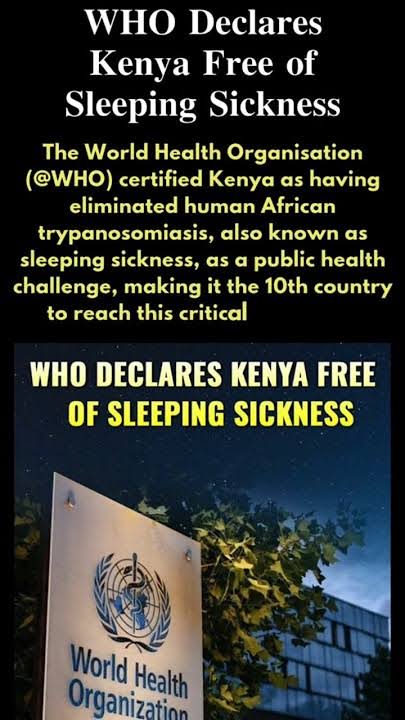
The World Health Organization (WHO) has confirmed that Kenya has eliminated human African trypanosomiasis, commonly known as sleeping sickness, as a public health problem. The announcement, made on 8 August, places Kenya among ten African countries that have reached this milestone. For a nation where outbreaks once devastated rural communities, the recognition is significant. But experts warn that elimination does not mean eradication, and vigilance will be required to ensure the disease does not return.
Sleeping sickness is caused by parasites transmitted through the bite of infected tsetse flies. In its early stages, the disease produces fever, headaches and joint pain. If untreated, the parasite crosses into the central nervous system, disrupting sleep and behaviour before causing death. Historically, outbreaks shaped settlement patterns and agricultural activity in regions such as Homa Bay and Lambwe Valley, where fertile land was often abandoned because of fear of the flies.
“This validation marks a major public health milestone for Kenya, as we celebrate the elimination of a deadly disease in our country,” said Dr Aden Duale, Kenya’s Cabinet Secretary for Health. “The achievement will not only protect our people but also pave the way for renewed economic growth and prosperity.”
Kenya’s progress reflects decades of work in surveillance, treatment and vector control. Health workers in endemic counties conducted systematic screenings, while research partnerships introduced new diagnostic tools and safer medicines. Treatments have advanced from highly toxic injections to fexinidazole, the first all-oral therapy, which simplified management and improved access. “This key milestone reflects Kenya’s efforts and commitment over many years, as a collaboration between national and county governments, national research institutions, development partners and affected communities,” said Dr Patrick Amoth, Director General of Health at the Ministry of Health.
The WHO stressed that continued surveillance is essential. Elimination as a public health problem means that transmission is under control and cases are rare, but the parasite has not disappeared entirely. “This success was made possible by the Ministry of Health’s leadership, the dedication of health workers in areas at risk and the support from key partners,” said Dr Abdourahmane Diallo, WHO’s Representative to Kenya. “Sustaining this will require resources and attention.”
Kenya’s validation follows similar achievements in Chad, Côte d’Ivoire, Togo and Uganda in recent years. WHO Director-General Dr Tedros Adhanom Ghebreyesus called Kenya’s progress “another step towards making Africa free of neglected tropical diseases.” The milestone aligns with the WHO roadmap to reduce the burden of such diseases by 2030.
International partners welcomed the news but also emphasised the ongoing risk. “This is an incredible achievement and is testimony to what can be accomplished through the investment and dedication of partners striving towards a common goal,” said Dr Ifedayo Adetifa, CEO of FIND, a diagnostics organisation that supported Kenya’s efforts. His colleague Prof Joseph Ndung’u, head of FIND’s Kenya office, noted that “HAT causes tremendous suffering, typically in communities that are already vulnerable. Eliminating this deadly disease as a public health problem is an important victory, and FIND is gratified to have been able to support Kenya in their efforts through strengthening the country’s capacity and its surveillance systems.”
Public health experts caution that the story is not over. Surveillance systems need sustained funding to prevent resurgence. Climate change, shifting ecosystems and population movements could alter the reach of tsetse flies. Other neglected tropical diseases, such as kala-azar and schistosomiasis, continue to affect Kenyan communities, often with far less attention and fewer resources.
About the Author